Sustainability and resource efficiency are becoming increasingly important in order to achieve ambitious energy transition targets and implement related decarbonisation projects in the property sector. The concept of smart buildings is becoming increasingly important in this context.
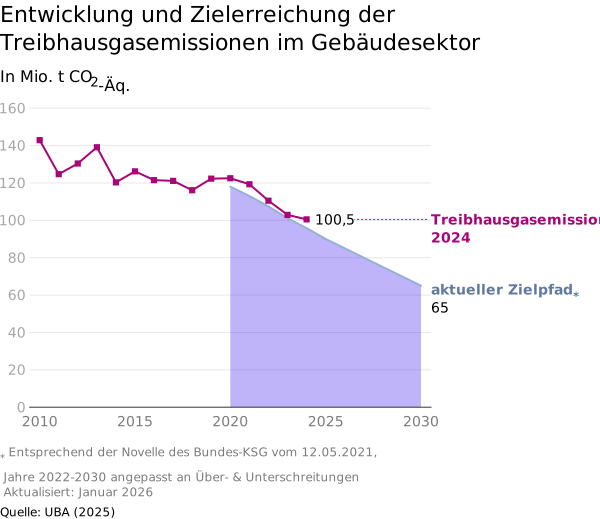
The dena Buildings Report 2026 shows that the buildings sector is still failing to meet its climate targets. Here are the developments that are now relevant to the housing sector – from renovation rates and heat pumps to data quality and strategic portfolio development.
How are CO₂ costs allocated between tenants and landlords? This article explains the legal requirements of the CO₂ Cost Allocation Act (CO₂KostAufG), the 10-step model, and the impact of rising CO₂ prices on heating costs, billing and the economic viability of building portfolios.
Between climate protection and economic efficiency: data-driven strategies for the housing sector. Online panel discussion as part of the Berlin Energy Days. Watch the recording now.
The energy performance certificate is an important document for the energy rating of properties. It documents the actual energy consumption of a building over a period of three years. It provides precise data on energy consumption per square metre and year for heating and hot water. As a transparent tool, it enables an informed assessment of energy efficiency, identifies potential savings and is therefore an important basis for planning refurbishment measures. In a market environment of rising energy costs, decarbonisation pressures and the growing importance of climate change mitigation measures, the energy performance certificate is an important indicator for property owners, as well as an important location indicator for buyers and tenants.
The housing industry faces the challenge of reconciling climate protection and affordable housing. IoT technologies offer a promising approach: they enable more efficient use of energy, reduce costs and create transparency - even in existing buildings. This article shows how it works and what solutions beyonnex, as part of the noventic group, offers.
If an investor is unable to realise a return because he does not receive repayment from the beneficiary of his investment for the newly created benefit, this is known as the investor-user dilemma. The legal requirements to modernise the energy efficiency of residential buildings in order to achieve the German government's climate targets by 2050 are a recurring problem. This is why the term landlord-tenant dilemma is also used in this context.
The housing industry is faced with the dual challenge of achieving climate neutrality and ensuring affordable housing. In this area of conflict, rental electricity is increasingly emerging as a promising solution that appears to be able to combine both objectives.
From 16 to 18 April, leading experts met on the digital stage at the Energy Days 2024 to discuss solutions for the energy turnaround in Germany.
In the panel 'Digital solution perspectives for the heating transition in existing buildings', Dr Rostami (KALO), Dr Metz (othermo) and Mr Wehrmaker (imovis) presented concrete solutions for climate protection that is sustainable for everyone. Dr Vogler (GdW) contributed the perspective of housing companies.
Poorly insulated' and #GivingWarmth are two slogans with which Hanseatic Help is drawing attention to the needs of Hamburg's needy. Exactly our theme. Because while the weather outside is miserable, we continue to work in the warmth to ensure that Germany finally heats in a climate-friendly way. But many people can neither make themselves a hot cup of tea nor turn up the thermostat to their heart's content.
That's why this year we're supporting the campaign of the charity Hanseatic Help together with employees, management and our canteen in Hamburg.
The discussion to introduce CO2 pricing for the building sector in Germany ran for several years at specialist level before politicians took up the idea and put it into practice. The German government's "Climate Protection Program 2030 for the Implementation of the Climate Protection Plan" stipulates that Germany should emit 55 percent fewer greenhouse gases by 2030. To achieve this, CO2 emissions are to be reduced across all sectors. Various laws are paving the way for this, such as the CO2 Cost Sharing Act, which is the focus of the following section.
When it comes to energy, the housing and property industry can be dizzy at times. With the amendment to the German Building Energy Act (Energieeinsparverordnung - EnEV), its short implementation periods and almost unattainable subsidies, the industry is at breaking point. Nevertheless, the rapid rise in energy costs cannot be ignored, nor can the property industry's necessary contribution to the energy turnaround. The fact is that of the almost 19 million residential buildings in Germany, the lion's share of around 12.4 million were built in 1979 or earlier - and are therefore at least 44 years old (source: Statistikportal).