Hintergründe
dena-Gebäudereport 2026: Developments that are currently relevant to the housing sector
Note: This article refers to the German dena-Gebäudereport 2026 (dena Building Report 2026), which is available in German only.
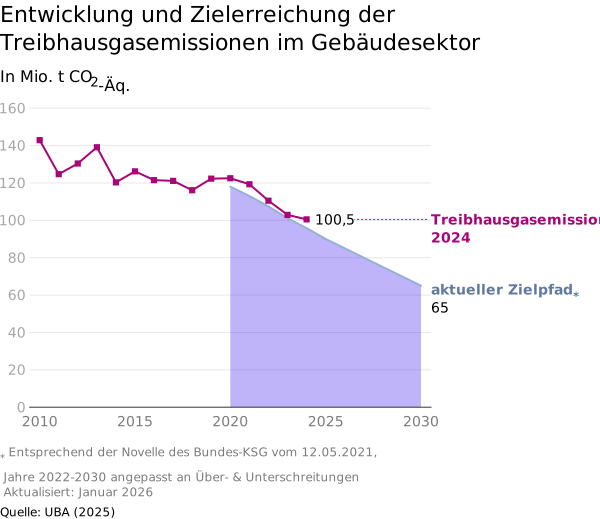
The buildings sector remains under pressure to transform. The latest dena-Gebäudereport 2026 shows that emissions in 2024 stood at 100.5 million tonnes of CO₂ – a 2.3 per cent decrease on the previous year and around 43 per cent below 1990 levels, but still above the target trajectory. Emissions would need to fall to 65 million tonnes by 2030. This is a target that dena considers achievable – provided that measures are implemented consistently and reliably.
For housing associations, property owners and energy service providers, the report confirms the key assessment: the greatest potential for action still lies in the existing housing stock. More than five million heating systems in Germany are over 30 years old. The proportion of heat pumps in the housing stock stood at just 4.3 per cent in 2024 – and the renovation rate fell to a historic low of 0.67 per cent in 2025. The following article explains what these figures mean in practice.
The development of the building stock in Germany
The key to climate protection and improving energy efficiency clearly lies in the existing building stock – simply because that is where the vast majority of buildings are located and, consequently, where the greatest potential for savings lies. This is because a large proportion of German residential buildings date from older construction periods and therefore have correspondingly lower energy standards: according to the Building Report, the proportion of buildings constructed since 2010 stands at only around 9 per cent. The vast majority of the existing building stock was therefore built to significantly lower energy efficiency standards – resulting in correspondingly higher heating requirements and energy consumption.


Data quality determines the prioritisation of remediation measures
One of the challenges facing building owners relates to data availability: for many older buildings, reliable information on energy consumption, heating systems, the building envelope and operational performance is often lacking or only available in a piecemeal fashion. This is because, as a rule, high data availability is primarily an issue for new-builds.
However, anyone wishing to prioritise investments in refurbishment and modernisation in a way that makes economic sense has no choice but to build up their own reliable database. Monitoring consumption, digital meter data and systematic recording of the building’s condition thus become essential prerequisites – not because the building report indicates this as a blanket requirement for the building stock, but because without this database it is impossible to make an informed decision on the order in which refurbishments should be carried out.
Why the buildings sector continues to fall well short of climate targets
The dena-Gebäudereport 2026 confirms once again that emissions from the building sector are exceeding the planned target pathway. The main causes are the persistently high proportion of fossil fuel heating systems and the slow pace of refurbishment. More than five million heating systems in the existing building stock are over 30 years old – a significant modernisation backlog that has a direct impact on the carbon footprint.
The problem is particularly evident in the renovation rate: by 2025, it had fallen to 0.67 per cent – the lowest figure in recent years (2024: 0.69 per cent, 2023: 0.70 per cent, 2022: 0.88 per cent). Of the approximately 19.5 million residential buildings in Germany, only a negligible proportion is therefore being energy-efficiently modernised each year. According to the dena flagship study, the figure should be significantly higher: for 2025, calculations suggest that around 460,000 refurbished residential units would have been necessary; in reality, the figure was 260,000. According to dena, demand will rise to as many as 730,000 units per year by 2030.
Nevertheless, the number of subsidised energy consultations rose by 30 per cent in 2024 compared with the previous year, reaching 163,872 – an indication that interest in refurbishment is growing, even if this has not yet been reflected in correspondingly high implementation figures.


Heat pumps, solar power and storage systems are developing at different rates
The transformation of the energy supply in the buildings sector is proceeding in anything but a uniform manner. Whilst electricity storage continued to grow strongly in 2025 – with total installed capacity rising to around 15.6 gigawatts – the expansion of rooftop solar panels slowed significantly: With 6.2 gigawatts of newly installed capacity by September 2025, it remained at a high level, but fell well short of the record years of 2023 and 2024.
The picture for heat pumps is more nuanced: in the existing building stock, their share stood at just 4.3 per cent in 2024 – almost double the figure from 2019, but still low given the size of Germany’s building stock. In new-build properties, however, heat pumps are already largely established. The dena update report from April 2026 also reveals a remarkable turnaround: in 2025, for the first time, almost half of all heating systems sold were heat pumps (48 per cent), whilst the share of gas heating systems fell to 44 per cent. Subsidy figures also support this trend – around 85 per cent of individual BEG measures for heat generators are now accounted for by heat pumps.


For housing companies, this means that a one-size-fits-all electrification strategy will not work. Not every building is suitable for a complete transition of its heating supply in the short term – investment costs, existing infrastructure and building structure determine the pace of change. A tailored approach to individual properties, aligned with actual consumption profiles and investment cycles, is therefore essential.
- Heat pumps: 4.3% market share in 2024 – almost double the figure from 2019, but in 2025, heat pumps will outsell gas heating systems for the first time (48% vs. 44%)
- Roof-mounted solar panels: Expansion significantly slowed in 2025 (6.2 GW by September) – lagging behind the record years of 2023/2024
- Electricity storage: Continued strong growth, total capacity around 15.6 GW
- Fossil fuel heating systems: Still dominant in the existing stock; over 5 million heating systems are more than 30 years old
- Renovations: Fell to 0.67% in 2025 – the lowest figure since records began
The consequences of these developments for the housing sector
The demands placed on housing companies are changing noticeably. Alongside rising energy costs, regulatory requirements, ESG criteria and reporting obligations are becoming increasingly important. Consequently, the focus is shifting towards transparency regarding energy consumption, the digitalisation of building data, the economic prioritisation of refurbishment measures, the decarbonisation of heating systems, as well as ESG reporting and regulatory documentation.
The ability to link technical, energy-related and business data is crucial in this context. Only in this way can measures be assessed across a building’s entire life cycle and property portfolios be strategically developed. Energy service providers also play an important role here: consumption data, monitoring and control information are increasingly being integrated into operational processes, rather than remaining isolated in billing systems.
Energy-efficiency renovations are increasingly being planned for the long term
The dena-Gebäudereport 2026 2026 clearly shows that energy-efficient refurbishments remain one of the most important levers for reducing emissions – yet at the same time, standardised solutions often reach their technical and economic limits when applied to a diverse building stock. Different years of construction, varying heating systems and individual building structures mean that refurbishment strategies must increasingly be planned on a long-term basis and tailored to specific properties. Key factors here include actual energy consumption, the condition of the building envelope, heating requirements and building services, investment cycles, regulatory requirements and the trend in operating costs.
One approach is becoming increasingly important: serial refurbishment. According to dena-estimates, around 30 per cent of all existing buildings are in principle suitable for this – using prefabricated façade elements that can significantly reduce refurbishment times and costs. In Efficiency House 55 and Efficiency House 40 projects, serial refurbishment now accounts for around 24 per cent of all projects. As a result, the focus of many companies is increasingly shifting from individual measures towards strategic refurbishment roadmaps for entire portfolios.
Conclusion: The existing building stock is becoming a key area for transformation
The dena-Gebäudereport 2026 clearly shows that the transformation of the buildings sector is a long-term endeavour. The greatest challenges lie in the efficient operation and gradual modernisation of the existing building stock – and thus in the areas where housing companies have the greatest influence.
At the same time, the falling renovation rate shows that technical solutions alone are not enough. The key will be the ability to permanently integrate energy efficiency, building operations and investment planning on the basis of reliable data. For housing companies that take this step at an early stage, their existing housing stock offers not only regulatory certainty but also economic potential.
About the author


Thomas Ahlborn
Head of Corporate Marketing, noventic group
Since 2013, Thomas Ahlborn has held various positions for companies of the noventic group, focusing on the theme of new supply concepts for neighbourhoods and buildings.